Educate
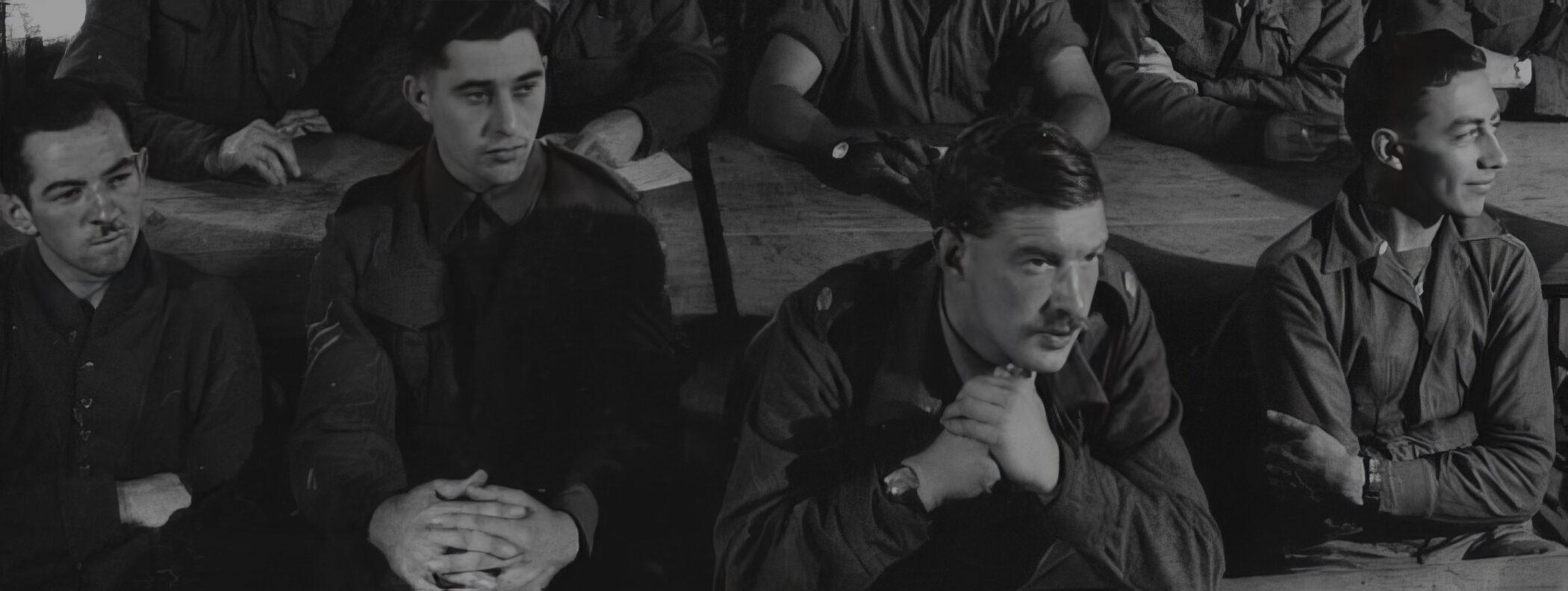
Our educational activities relate to the general public wherever possible and we frequently lecture to local community groups for a fee that helps support our other activities. We are also, as part of our aim to INSPIRE, committed to educating the modern-day military and cadets.
One of the driving forces in our charity’s establishment was the knowledge that very few people were aware of the ‘secret war’ aspects of WW2 and that those who were aware tended to be the next generation down of those who had served during the war. As the veterans themselves dwindled in number, to be inevitably followed by the generation of their daughters and sons, our Co-founders (Martyn Bell and Martyn Cox) were determined that we should reach beyond these generations. We therefore partner with museums where school children will see our presentations and directly young people via schools, colleges, universities and cadet forces.
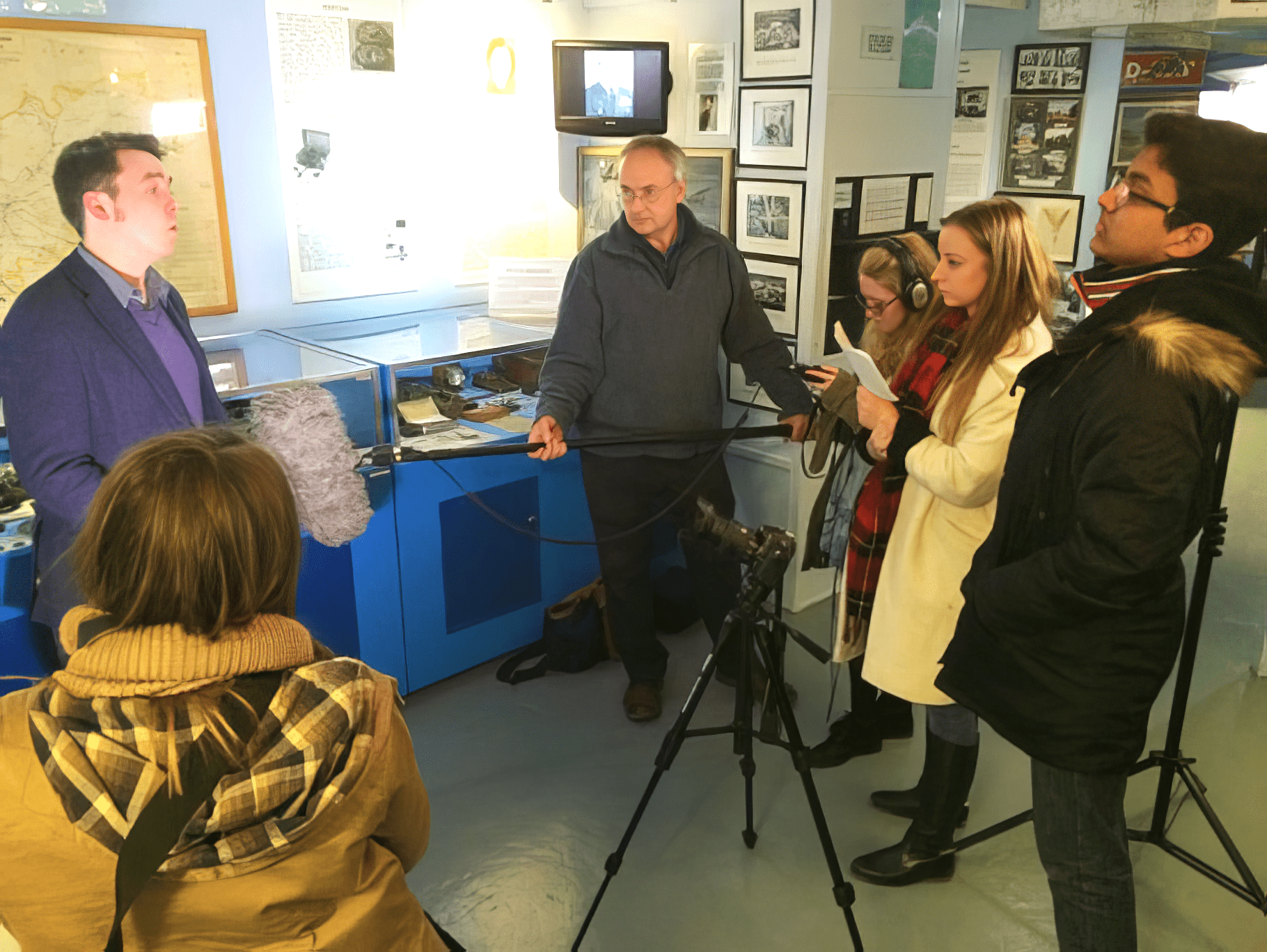
Students from University of Chichester in a Secret WW2 project visiting Tangmere Military Aviation Museum in Sussex.
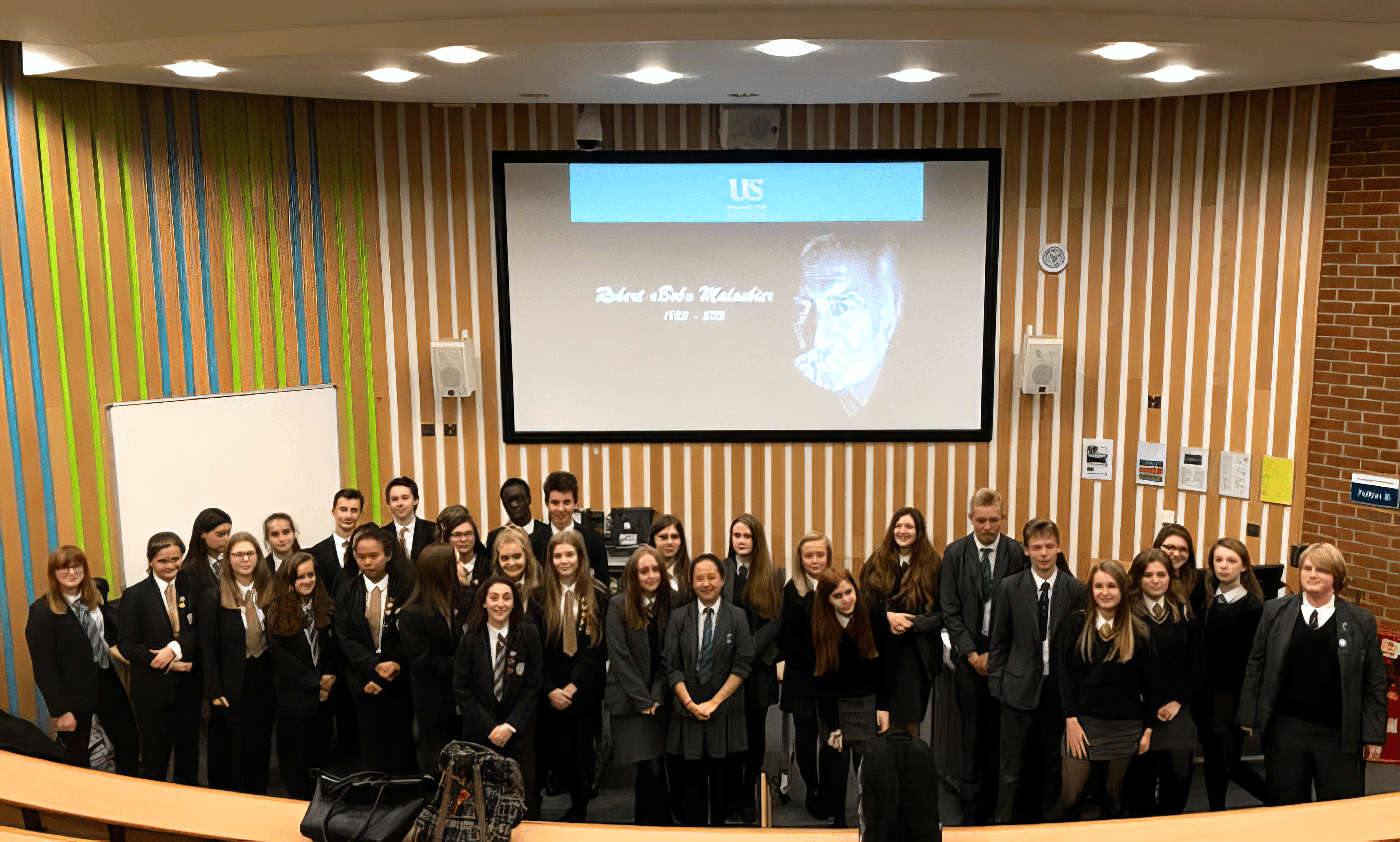
Students at Brighton College after a Secret WW2 presentation.
In more recent years we have introduced two ongoing projects: university-level bursaries and a contribution to a Mobile Teaching Unit in India, which are described in more detail below.
THE STEVE WEISS RESEARCH BURSARIES
THE STEVE WEISS STUDENT RESEARCH BURSARIES
Two Bursaries have been created and funded by Secret WW2 – The Secret WW2 Learning Network in memory of Dr Stephen Weiss, a WW2 veteran and UK-based academic and writer who died in 2020, aged 94. Steve Weiss was a subscribed Friend and strong supporter of Secret WW2, a wonderful character who was well-known to many members of the charity. His obituary is given as the appendix to this document.
The purpose of the Bursaries is to enable each award winner to undertake a study, or complete part of a larger study, which would necessarily involve travelling to undertake research. Each Bursary will provide finance to a maximum of £1,000 for travelling, accommodation or other related expenses. Retrospective awards will not be considered.
Eligibility
The Bursaries are open to students of a relevant study course (e.g. History, International Relations, Politics, War Studies) at the University of Chichester or King’s College London and subscribed Friends of The SWW2LN studying at any other university that is approved by The SWW2LN. Two bursaries are available each year, normally no more than one bursary will be granted to each university, though this may be varied according to demand e.g. in the event that one Bursary does not attract a suitable application, it may be allocated as a second Bursary to another university. Awards are open to students registered on full-time traditional or distance learning programmes. Students working and studying part-time who are able to
clearly demonstrate financial need are also eligible.
The Bursaries are intended for:
• undergraduate students (e.g. BA/BSc) who have to undertake a final year project involving original research in a secret/clandestine aspect of the Second World War
• postgraduate taught students (e.g. MA) who have to undertake a dissertation involving original research in a secret/clandestine aspect of the Second World War
• postgraduate research students (e.g. MA by Research, MPhil or PhD) who have to undertake a thesis involving original research in a secret/clandestine aspect of the Second World War.
For further information and how to apply, see our dedicated web page at The Steve Weiss Student Bursaries – Secret WW2
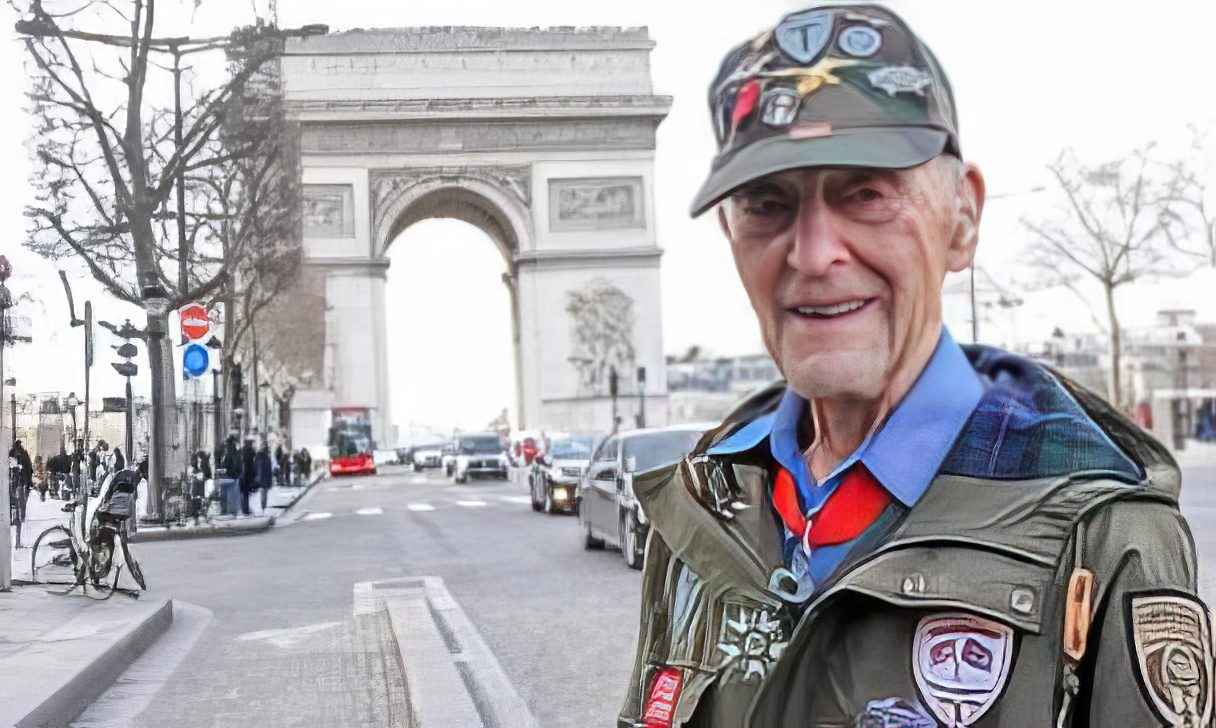
Photo credits: top of page of Steve at the Arc de Triomphe in Paris, February 2020 by Chad Garland/Stars and Stripes; below at Valencay in 2021.
Stephen Weiss obituary
By Steve’s daughter, Claudia Pétursson and published in The Guardian, 27th February 2020.
My father, Stephen Weiss, who has died aged 94, was a member of “the greatest generation”, who fought in the second world war. He was on the frontlines in France in the summer of 1944. Caught in a firefight in the Ardèche region, he and seven others were separated from their unit and hunted by Nazi forces. A farmer, Gaston Reynaud, hid the Americans in his hayloft. With help from the French Resistance, they organised their escape. Dressed in police uniforms, they crossed enemy lines, beginning a harrowing journey to safety.
Steve was born in Brooklyn, New York, to Jeanette (nee Seidman), a seamstress, and William Weiss, a bodyguard. In 1942, immediately after graduating from Lafayette high school, Brooklyn, he volunteered for service in the US army.
At the end of the war, he worked for the Department of the Army as a photographer based in Paris. He travelled all over Europe recording the devastation of war, venturing as far north as Norway and as far south as Sicily. His photos are a part of the US National Archives. He returned to Brooklyn in 1946 and spent about six months in intense treatment for PTSD. He learned to manage it, and became involved in supporting affected veterans.
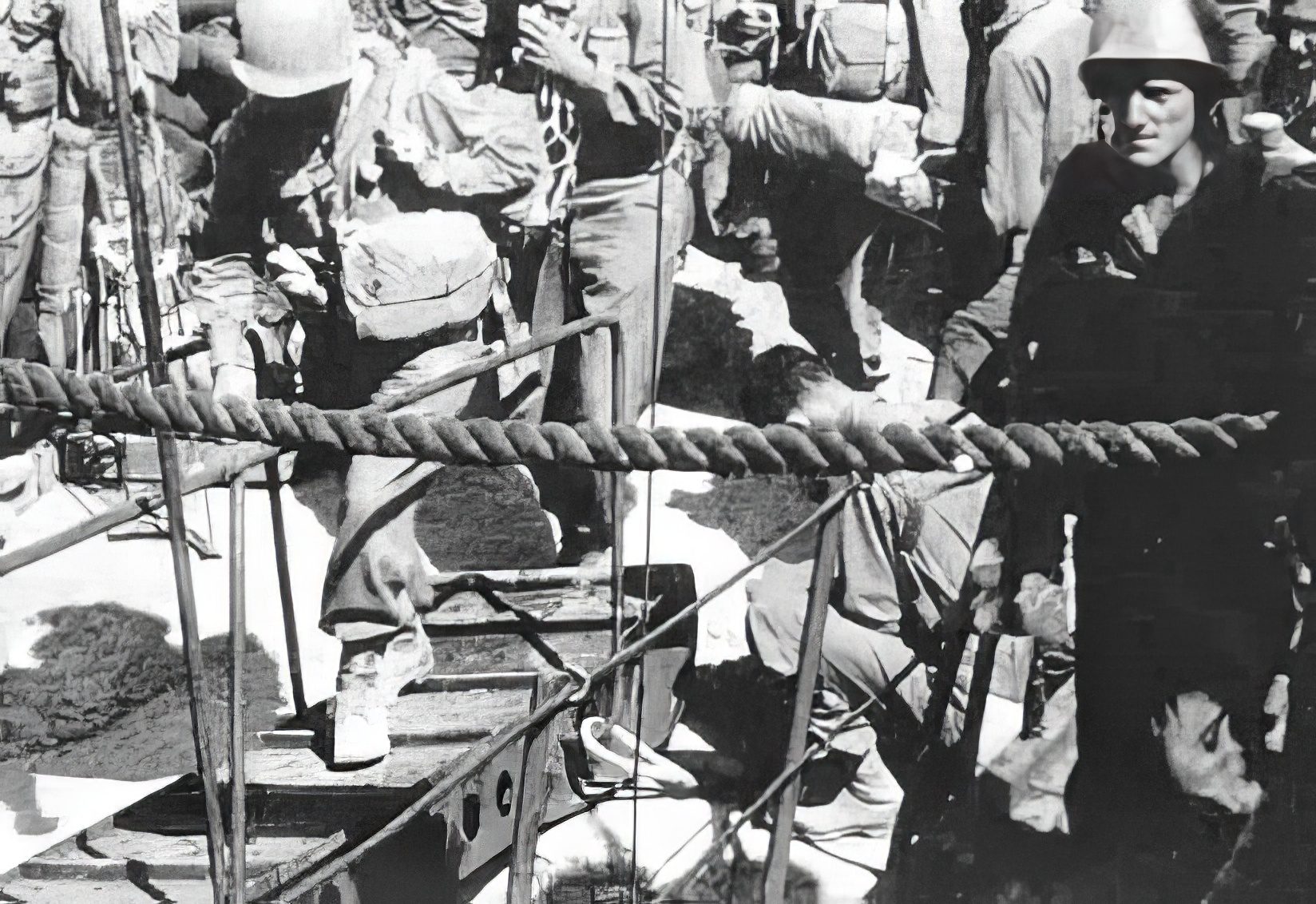
Steve Weiss, far right, boarding a troop ship in the USA, bound for France during the Second World War.
Around 1948, he travelled to Los Angeles, where he enrolled at radio and television school. He was hired by CBS, and worked in the entertainment industry for the next 30 years. In LA he met Rosemary Valaire, a former Royal Ballet dancer, who was teaching at the American Ballet School. They married in 1957, and had two daughters (my sister, Alison, and me) and a son (my brother, Andrew).
Steve worked in sound editing at CBS, ABC and various Hollywood editing firms until 1989, when he decided to take early retirement and pursue his interest in military history. He had already studied for a master’s in psychology at Goddard College, Vermont, in 1976. Because he wished to know more about the part of the war in which he had fought, he was advised to study in Europe and pursued doctoral studies at King’s College London. He received a master’s in war studies in 1990 and a doctorate in 1995.
Steve became an extremely popular lecturer at King’s from 1995 until 2020, and was made a KCL fellow in 2019. He authored two books, Allies in Conflict (1996) and The Invisible Scars of War (2011). My father was made a Chevalier de la Légion d’honneur in 1999, then Officier in 2007 and Commandeur in 2013. He also received the US Bronze Star, the French Médaille de la Résistance and two awards of the Croix de Guerre. In February 2020, he travelled from London to participate in the 75th anniversary commemoration of the US Office of Strategic Services in his beloved Paris, the city he fell in
love with as a young soldier, to lay a wreath on the grave of the unknown soldier under the Arc de Triomphe. Steve is survived by his children, Alison, Andrew and me, and by eight grandchildren and a great-grandson.
Claudia Pétursson
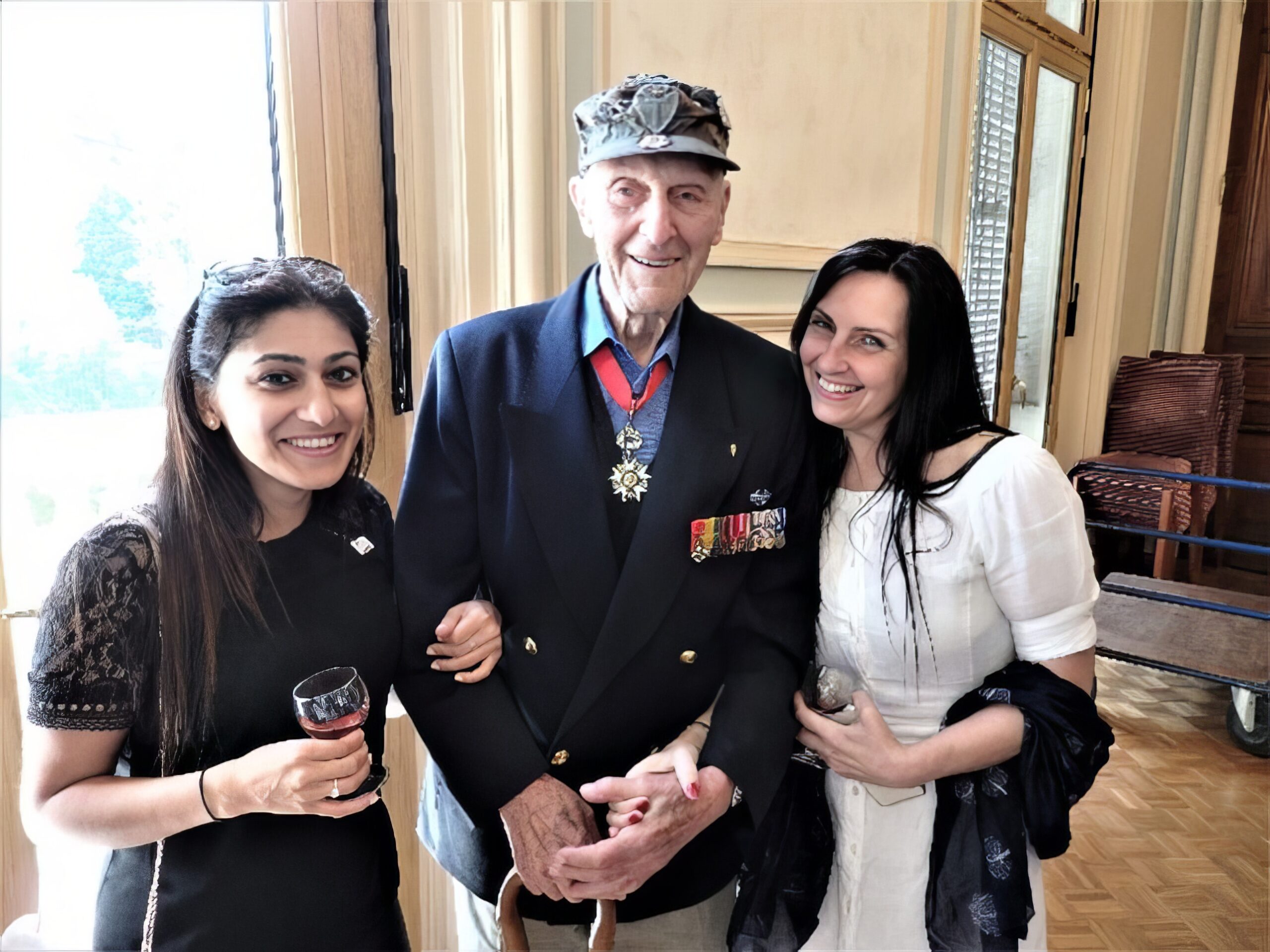
Steve with members of Secret WW2 at Valençay, France in 2019
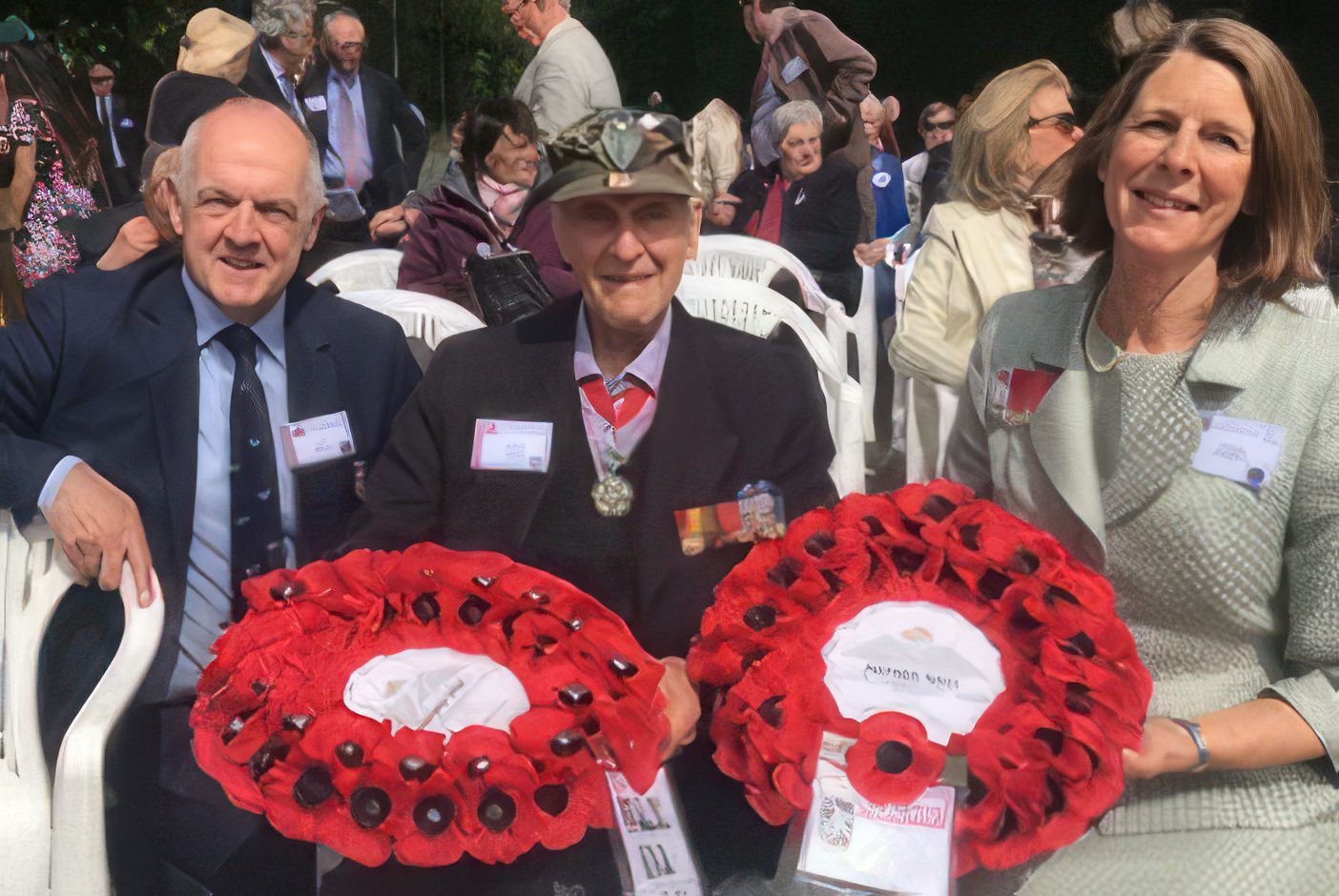
Steve with Secret WW2 Chair Louisa Russell and Executive Trustee Paul McCue at Valençay, France in 2019
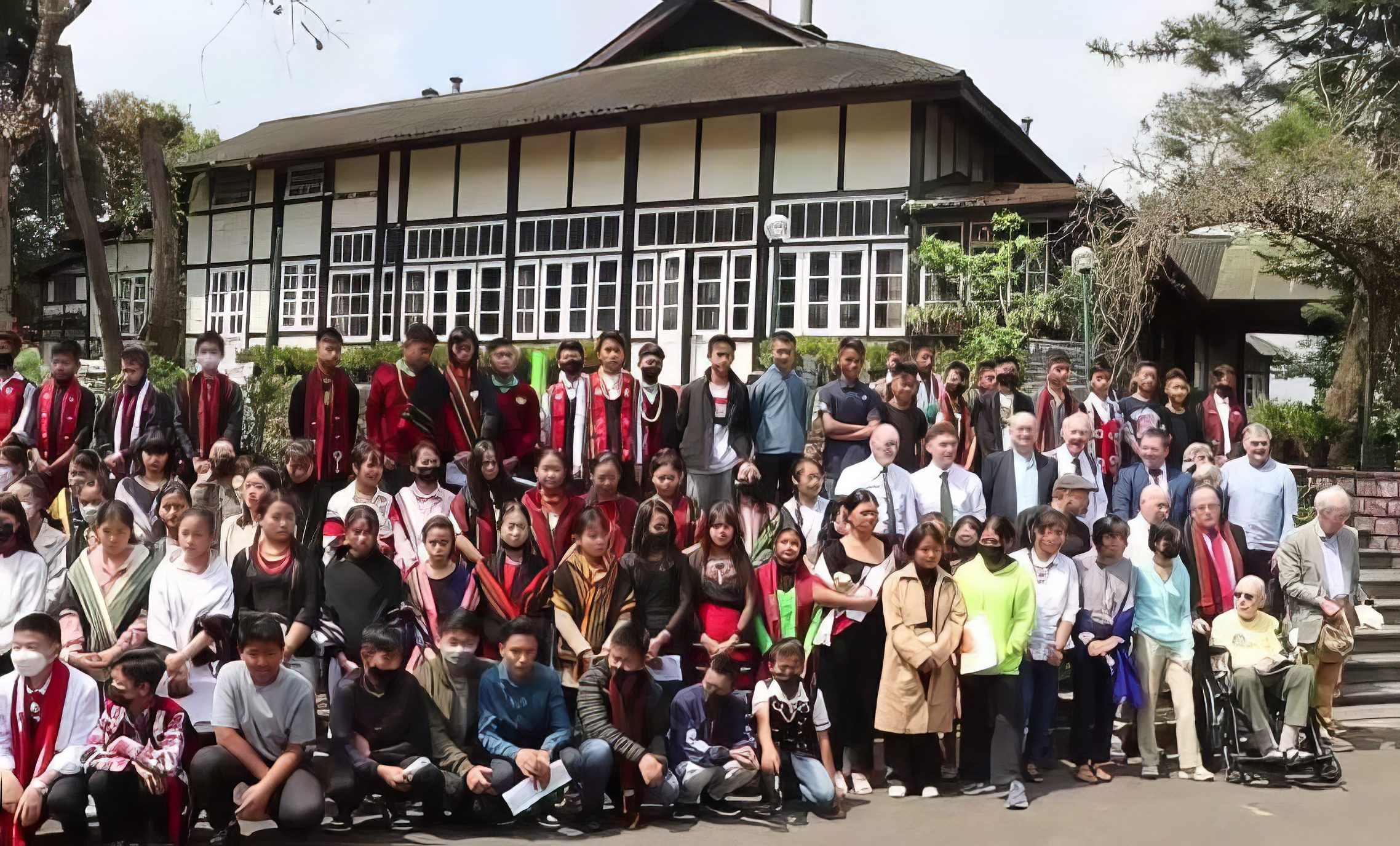
OUR SECRET WW2 CONTRIBUTION IN INDIA
IN MEMORY OF URSULA GRAHAM BOWER MBE
One of our regular Zoom presentations in 2021 was a film made for the Royal British Legion by our Co-founder Martyn Cox. See https://vimeo.com/457166843
The film’s subject was Ursula Bower and the Naga people who helped her establish a scouting and reconnaissance unit for V Force on the India/Burma border during WW2. While we subsequently and initially thought of funding a commemorative plaque in India, our Secret WW2 Trustee and Treasurer, Ashley Barnett, came up with a far more meaningful suggestion after hearing of scholarships for the Naga people, granted via the Kohima Educational Trust. After approval from the SECRET WW2 Board of Trustees for a three-year scholarship, 2022-25, our contribution to the region and to remembering Ursula Bower’s contribution has developed, from 2026, into helping the Kohima Educational Trust (KET) fund a Mobile Teaching Unit that aims to reach up to 1,000 children aged between 8 and 14 across Nagaland. See: Mobile Teaching Unit – Kohima Educational Trust
When the original scholarship was set up, Ashley funded his own trip to India on a Kohima and Imphal battlefield tour and reported:
“As part of my pre-trip reading, I purchased a copy of ‘Naga Path’ by Ursula Graham Bower MBE, in the hope of gaining an appreciation of the local population.
Like myself, Ursula’s first visit to India came in her twenties, with my visit in 2022 separated by 85 years since Ursula’s in 1937.
As I read ‘Naga Path’, the explorer within me was captivated by her remarkable story. I speculate that like myself, Ursula would not have been satisfied by a beach holiday, but instead yearned to travel to learn more about our vast world.
My visit to Kohima and Imphal was owing to a desire to see and understand the battlefield, I was drawn by military history you could say. For Ursula it was anthropology which warranted her visits. A passionate desire to document the lives of the local Naga tribes.
Following her initial visits to India in 1937 and 1939, Ursula found herself in London for the start of the war, however, she was subsequently able to gain permission to return to the Naga Hills and live among the Naga people in Laisong Village. Here she won the hearts of the local people, who had already won her heart alongside the beauty of the Naga Hills.
With the progress of the Japanese forces through Burma and the serious threat of the invasion of India, Ursula now found herself on the doorstep of destiny.
The British administration asked Ursula to mobilise her local Nagas into a scout unit within V Force, itself a reconnaissance, intelligence-gathering, and guerrilla organisation, very much within the remit of SECRET WW2. A watch-and-warn system was established, filtering the flow of allied movements out of Burma, and aiming to ambush Japanese parties as they advanced.
Her force of over 100 Nagas grew in size and confidence under her leadership, buoyed by supplies of arms and reinforcements, they became known as ‘Bower Force’.
Ursula received the Lawrence Memorial Medal in 1944, named after Lawrence of Arabia and awarded for Ursula’s anthropological work among the Nagas. Ursula was appointed Member of the Order of the British Empire in 1945.
While serving with V Force Ursula encountered Lieutenant Colonel Frederick Nicholson Betts, who she later married in 1945. Their marriage brought two children, Catriona and Alison.
Inspired by Ursula’s story, I was keen to commemorate her in an appropriate manner. This led me to the Kohima Educational Trust (KET) (https://www.kohimaeducationaltrust.net/), which was set up by veterans of the battle in recognition of a debt of honour to the Naga people:
“The trust is seen by its founders both as a means of sustaining the memory of the courage and sacrifice of those who fought and died in the battle, and of honouring the Nagas who were their allies in the war through assisting the education of succeeding generations of Naga children.”
The KET awards hundreds of scholarships on an annual basis to local Naga children, initially supporting their education for a 3-year term, with an option of extending to a 5-year term.
I was grateful to receive the backing of Secret WW2 to award a 3-year scholarship, in recognition of Ursula Graham Bower.
Fortunately, a battlefield tour was timed to coincide with the annual awards ceremony, and having signed up for it I had the honour and privilege of representing Secret WW2 on the day, and directly presenting our scholarship to ‘our’ student. It was an emotional and humbling experience for me.
More on the ceremony can be found here: https://www.kohimaeducationaltrust.net/news-and-events/news/ket-scholarships-awards-ceremony-2022
Following the conclusion of the ceremony I met with ‘our’ student and her father. Both could not thank us enough for our support,
For someone who has benefited from the UK’s state education, it was a humbling experience to see how far £125 (the annual scholarship fee) can really go. We met several students who had completed their scholarship and had moved on to further education and enhanced opportunities.”
Ashley Barnett 2022.
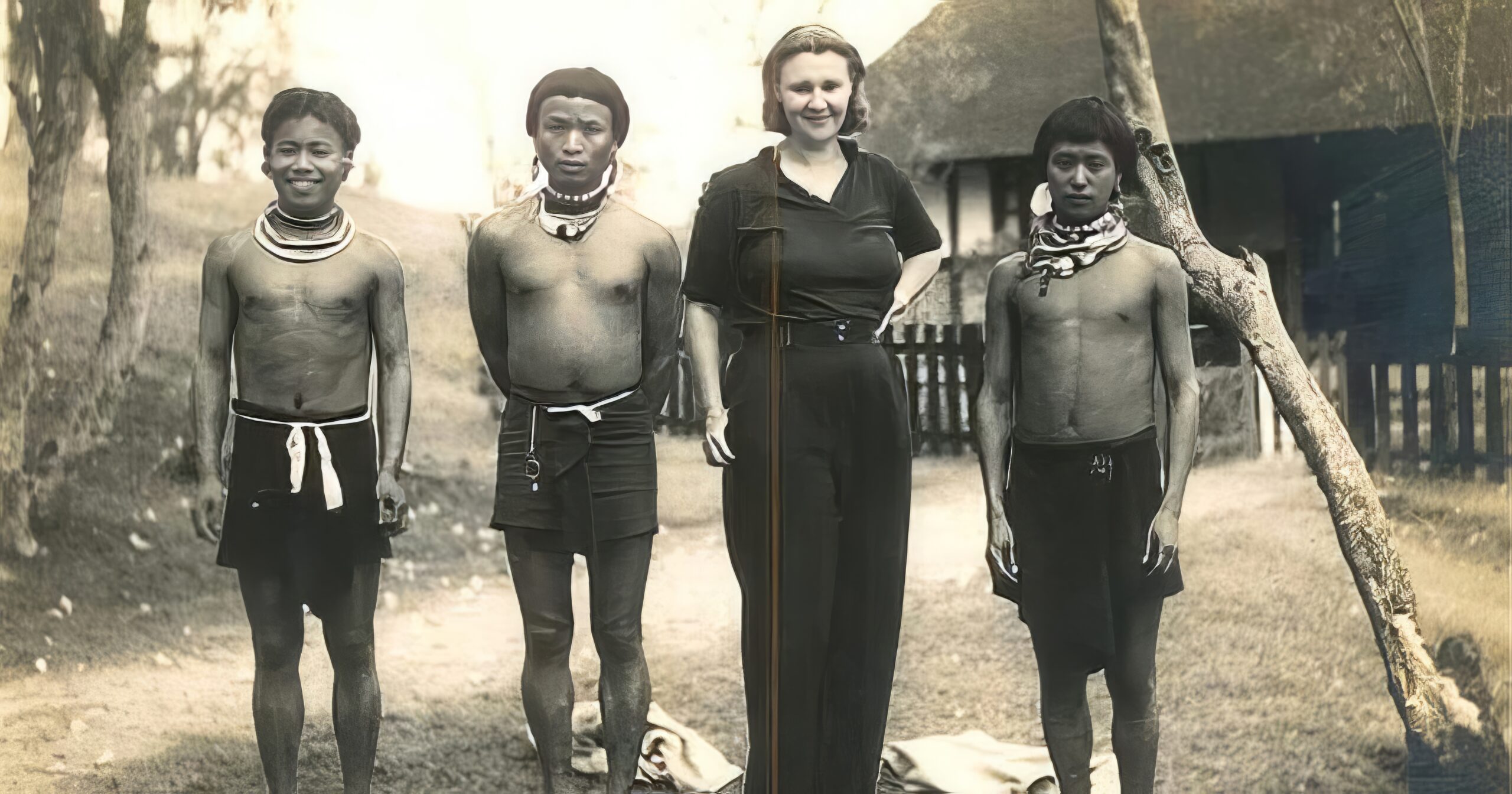
Ursula Bower among the Nagas.
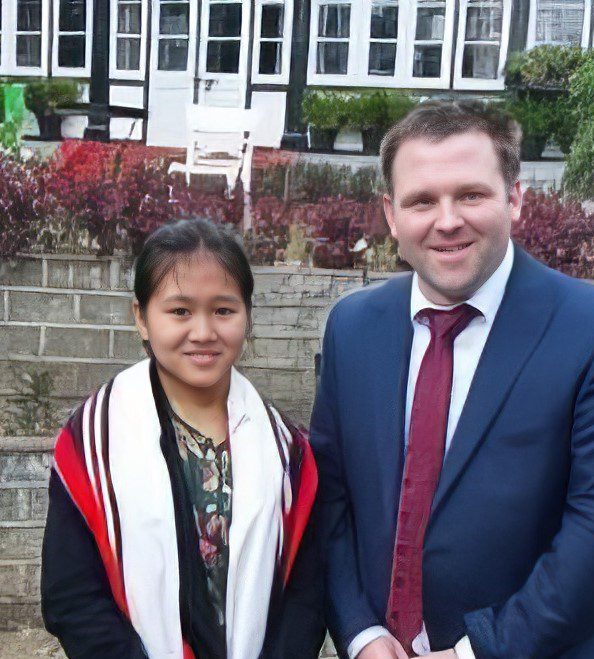
Trustee, Treasurer and Projects Officer Ashley Barnett with our first scholarship recipient in India.