The Special Operations Executive (SOE)
– a timeline of developments, ‘firsts’ and major achievements.
September 1939 – The United Kingdom enters the Second World War after declaring war on Nazi Germany following its invasion of Poland. France signed an armistice with Germany in June 1940 and Italy declared war on the United Kingdom.
July 1940 – SOE is formed by the amalgamation of three existing organisations: MI (R) – a branch of the War Office, EH (Electra House) – a secret section in the Foreign Office, and Section D – an equally inadmissible element within MI6, more properly titled the Secret Intelligence Service (SIS). Neither Parliament, nor the British public, was informed of SOE’s existence and for most of the war it operated under the cover name of the Inter-Services Research Bureau (ISRB). SOE was made responsible to Dr (later Sir) Hugh Dalton, the Minister for Economic Warfare in Prime Minister Winston Churchill’s wartime coalition government. Churchill issues SOE with the directive to ‘Set Europe ablaze’ as an early priority
August 1940 – Sir Frank Nelson, formerly of Britain’s Secret Intelligence Service (SIS/MI6), is appointed the first head of SOE, known as ‘CD’.
November 1940 – SOE’s five-man Military Mission 104, led by Lt-Colonel J.C. Mawhood, arrives in Australia. It establishes the Independent Company Training Centre at Wilsons Promontory, Victoria for training Australian and New Zealand soldiers in special forces/commando skills.
December 1940 – after leaving temporary offices in St. Ermin’s Hotel and Caxton Street, London SW1, SOE’s headquarters are consolidated in 64 Baker Street, London W1 with other offices requisitioned nearby eg 83 Baker Street (Norgeby House) housed several Country Sections, including those for France, Belgium, the Netherlands, Poland and (the former) Czechoslovakia.
The first SOE-organised agent training course in the UK consists of Republican Spaniards, codenamed SCONCEs and antifascist Italians, codenamed QUINs. They are trained at Station XVII (Station 17 – later STS 17), ‘Brickendonbury’, Hertfordshire and at STS 21 ‘Arisaig House’ in Inverness-shire. From Section D of the Secret Intelligence Service (SIS), one of SOE’s predecessor organisations, SOE had inherited an earlier course of trainees attending Station XVII ‘Brickendonbury’ from August 1940. This consisted of six Belgians, five Norwegians, three French and eleven Republican Spaniards.
January 1941 – SOE’s Special Training Schools (STS) are opened around Britain. Use of large country houses leads to the quip that SOE stands for ‘Stately ‘Omes of England’. The first course at STS 1, ‘Brockhall’ in Northamptonshire consists of Danish volunteers. It includes Private Anders Lassen who will later transfer to the Special Air Service (SAS) and win a posthumous Victoria Cross in the SAS’s Special Boat Service in northern Italy in April 1945.
February 1941 – in Operation ADOLPHUS the Royal Air Force drops by parachute the first SOE/Polish Free Forces mission of three agents into Poland.
The first active service SOE casualties are incurred 24th February 1941 when the SS Jonathan Holt is torpedoed by U-97 and sunk en route from Liverpool to Takoradi, Gold Coast (now Ghana). Lost at sea, believed drowned, are Franz Preiss (Sudeten Czech), Theodor Schubauer (Austrian), Lieutenant David Maitland-Makgill-Crichton (British) and Captain John Gabriel (British).
March 1941 – Operation SAVANNA by RF (Free French) Section, SOE, is the first mission into occupied France.
April 1941 – SOE establishes its first overseas training establishment, STS 101, for its Oriental Mission in Singapore, training agents for despatch into Malaya and Thailand to prepare resistance to expected Japanese invaders.
Virginia Hall, a US citizen, is recruited as a trainee agent by SOE’s F (French) Section, despite having a prosthetic leg from a shooting accident.
Volunteer Fortunato Picchi is executed by firing squad at Fort Bravetta on the outskirts of Rome on 6th April 1941. He had been recruited and trained by SOE before being attached to Operation COLOSSUS, a raid by 11 Special Air Service Battalion, on the Tragino aqueduct in Italy. He parachuted with the force on 10th February 1941 as an interpreter. Captured, he was tried and, as an Italian national, sentenced to death for treason. He is believed to be the first SOE agent executed.
May 1941 – Captain Georges Bégué MC, is the first agent of SOE’s F (French) Section to be parachuted into France. Soon after, Gigliana Gerson (née Balmaceda), a Chilean national, is the first woman agent of SOE’s F Section to be sent (overland via Spain) to France. They would be followed by approximately 430 F Section agents to lead and train resistance groups for the liberation of France.
Sergeant Émile Tromme is the first agent of T (Belgian) Section to be parachuted into occupied Belgium. He was to be captured in November 1941 and executed in February 1942.
Operation BOATSWAIN is the first joint operation, ending in tragedy, of SOE and the newly formed Palmach, the paramilitary unit of the Jewish community in Mandate Palestine.
July 1941 – SOE’s India Mission, originally titled GSI(k) is established and develops an extensive training structure across the sub-continent.
August 1941 – the second overseas training establishment, STS 102 (also known as ME 102) opens near Haifa in Mandate Palestine, now Israel. Training is largely for SOE operations in the Balkans and eastern Mediterranean on behalf of SOE’s Force 133 headquartered in Cairo, Egypt.
Virginia Hall is sent to France as a courier and contact for future arriving F Section agents. Her cover is as a neutral US journalist. Her prosthetic leg would not prevent her from crossing the Pyrenees mountains on foot when escaping from France into Spain in 1942.
September 1941 – Premier Stalin of the Soviet Union and Prime Minister Winston Churchill of Britain sign an agreement for SOE to train and despatch 62 agents of the Soviet secret service, the NKVD, into western Europe. Only 25 proved suitable to be dropped in nine PICKAXE teams: three to Germany, Austria and Holland/Belgium, five to France and one to Italy from January 1942 to September 1943. Also in September 1941, SOE dispatches the first of over 20 missions to (the former) Yugoslavia to assess and co-ordinate resistance forces. SOE subsequently provided significant support to the communist Partisans under Gen Tito.
November 1941 – SOE’s first two Dutch agents, Huub Lauwers and Thys Taconis, parachute into the Netherlands. Lauwers is captured in March 1942 and becomes the first victim of the German’s counterintelligence operation ‘Das Englandspiel’ (the England Game).
December 1941 – STS 103 (‘Camp X’) is established in Canada for training Canadian agents for Europe and for liaison with the then still-neutral American intelligence and special forces organisations. The latter responsibility is overtaken by events when the Japanese bomb the US fleet at Pearl Harbor and the USA enters the war.
December 1941 – The United Kingdom declares war on the Empire of Japan following Japanese attacks on British Malaya, Singapore and Hong Kong and in response to the bombing of the US fleet at Pearl Harbor.
January 1942 – Operation POSTMASTER, the seizing of enemy shipping in the harbour at Santa Isabel on the Spanish island of Fernando Po (now Bioko in Equatorial Guinea) off the West African coast, is conducted by SOE agents and SOE’s Small Boat Section – later the Small Scale Raiding Force.
February 1942 – Dr Dalton is replaced as the responsible Minister by Roundell Palmer, Third Earl of Selborne, a personal friend of Churchill. Selborne continues in the role throughout SOE’s existence.
May 1942 – Sir Frank Nelson retires due to ill health and is replaced by Sir Charles Hambro as ‘CD’ of SOE.
May 1942 – the initial headquarters of the Inter-Allied Services Department (ISD) is created secretly by SOE in Melbourne, Australia, in conjunction with the Australian, US and Dutch military authorities. In April 1943 ISD became Special Operations Australia (SOA), under the cover name of Services Reconnaissance Department (SRD) and continued to employ many SOE personnel from Britain.
May/June 1942 – Reinhard Heydrich, head of the German Reich Security Main Office, acting governor of the Protectorate of Bohemia and Moravia and principal architect of the Holocaust, dies after an assassination attack carried out by Czechoslovak agents trained and despatched from Britain by SOE. Heydrich was mortally wounded in the attack in May and died in June.
July 1942 – the first fully trained woman SOE agent to be sent to occupied Europe, Jacqueline Rudellat, arrives in France by sea. In September, the first two women agents to parachute into France arrive – Andrée Borrel and Lise de Baissac.
October 1942 – Lieutenant Mogens Hammer, a Danish agent of SOE, makes the first known operational parachute jump into the sea when he is dropped 150 yards off the shore of Zealand, Denmark and safely makes his way to shore. He successfully carries out this, his second, mission, but is killed shortly after the war in an accident in January 1946.
November 1942 – SOE despatches the BRANDON Mission to North Africa to work behind enemy lines in support of Operation TORCH, the Allied invasion of North Africa. The same month SOE establishes MASSINGHAM, a base near Algiers, to act as the springboard for covert operations in support of the Mediterranean campaign.
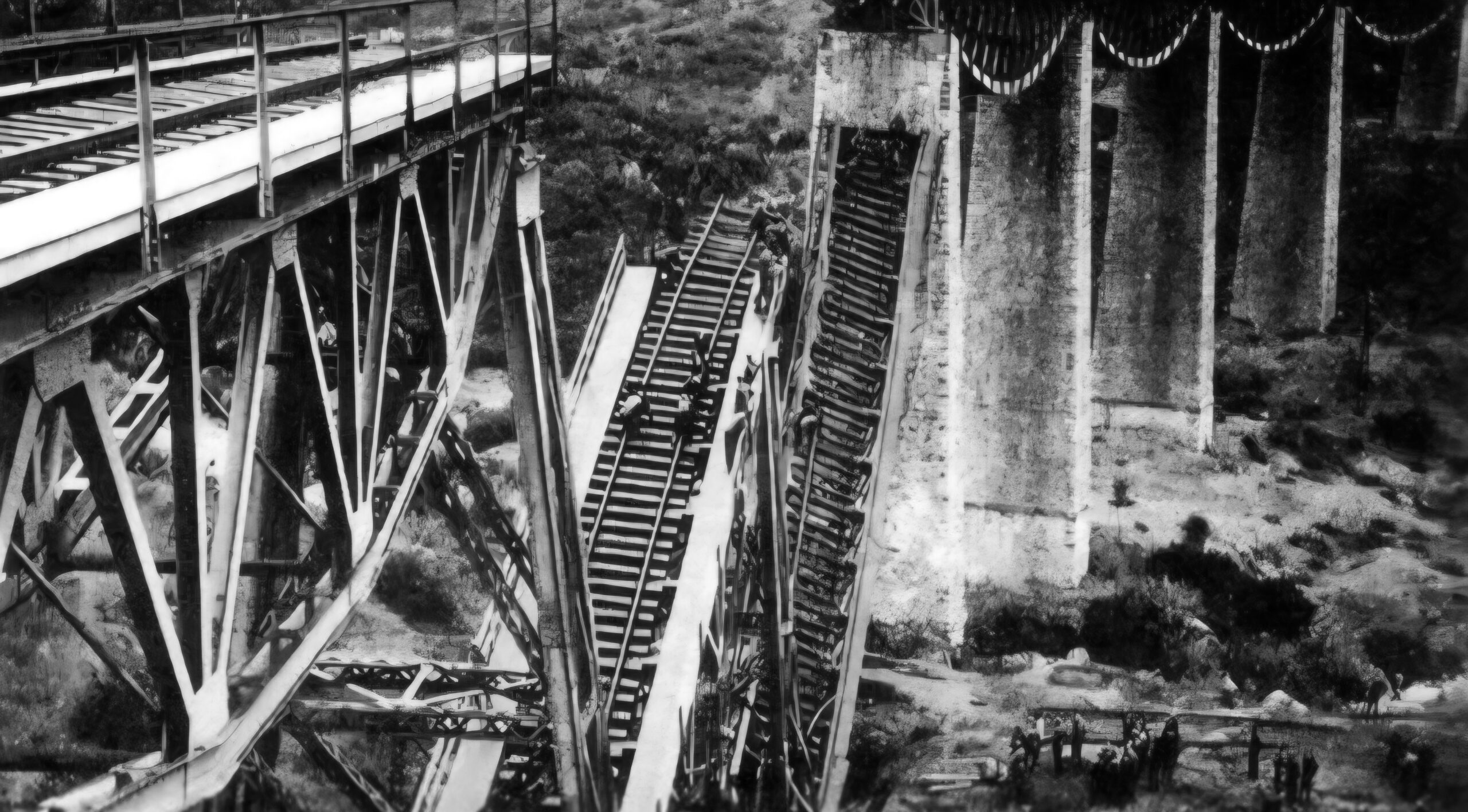
SOE’s first major sabotage mission, Operation HARLING, successfully destroys the viaduct and railway line over the Gorgopotamos river in Greece. The railway line was an important supply route for Nazi forces in North Africa.
February 1943 – SOE-trained Norwegian commandos are dropped by parachute in Operation GUNNERSIDE and successfully attack the Norsk Hydro power station at Vemork, Telemark in German-occupied Norway. The operation puts back production of ‘heavy water’, needed for the Nazis’ atomic weapons programme, by many months and is considered one of the most important sabotage acts of the Second World War. From early 1941 SOE had also used a clandestine boat service, ‘The Shetland Bus’, between the Shetland Islands and Norway.
August 1943 – SOE agent Dick Mallaby is parachuted into Italy. Although caught, he subsequently plays a major role in negotiation contacts that bring about the Italian surrender in September 1943. Mallaby was again caught in 1945, but then assisted SS Obergruppenführer Karl Wolff in starting secret negotiations with the Allies via Switzerland.
September 1943 – Italy surrenders to the Allies.
September 1943 – Sir Charles Hambro resigns following a disagreement with Lord Selborne over policy and Major-General (later Sir) Colin Gubbins replaces Hambro as ‘CD’ for the remainder of the war.
September 1943 – Operation JAYWICK is an SOE-devised sabotage mission that involves three British and eleven Australian commandos and sailors of SOE and SOA. They raid Japanese shipping in Singapore Harbour, sinking or severely damaging six ships, in what is described as the most successful maritime sabotage operation of the Second World War.
December 1943 – flights for SOE operations in Europe are temporarily halted following the discovery that the SOE network in Holland has been comprehensively penetrated by the Nazis (Das Englandspiel), leading to 54 agents being captured and killed. SOE operations in Holland needed to start all over again in 1944.
April/May 1944 – SOE officers and members of the Greek resistance kidnap Major-General Heinrich Kreipe, commander of the 22nd Air Landing Division, on the Greek island of Crete and take him to Egypt.
June 1944 – after clandestine training and operations since 1941, SOE circuits in Belgium and France rise up in support of the Allied invasion of Europe and small, uniformed, (normally) three-man JEDBURGH teams are parachuted behind the lines in occupied France. Prisoners of War taken in Europe are screened for anti-Nazi or other suitable candidates for training and dropping into Austria and Germany.
December 1944 – SOE’s India Mission is renamed Force 136 and continues operations in the far east in Burma (chiefly), Malaya and to a limited extent in Thailand, French Indo-China (now Vietnam, Laos and Cambodia) and China.
May and August 1945 – surrender, respectively, of Nazi Germany and the Imperial Japanese forces.
January 1946 – SOE, established as a wartime-only organisation, is disbanded.
Paul McCue, Secret WW2 – The Secret WW2 Learning Network, revised February 2026
(please feel free to contact us at [email protected] if you feel any notable element is missing from the above list)
With thanks for contributions from Steven Kippax, Colonel (retd) Nick Fox OBE, Wolfgang Rongen.
Title photo: November, 1942 – SOE’s first major sabotage mission, Operation HARLING, successfully destroyed the viaduct and railway line over the Gorgopotamos river in Greece.